Dance from
the Baroque period is the forerunner of western theatrical dance
as we know it today. It contains a unique vocabulary of steps and
ornaments that formed the basis of classical ballet later in the
18th century. Until recently, many of these steps were forgotten.
The dance style is vigorously musical, with fleet footwork, florid
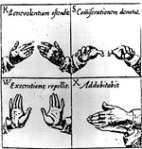
accents of the arms, a dramatic system of gesture, and it encompasses
a striking range of material: elegant court dances, virtuosic theatrical
ballets, and raucous dances related to the Italian commedia dell'arte.
These dances
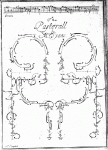
of the 17th and 18th century were preserved for posterity thanks
to the efforts of the dancing masters Pierre Beauchamps and Raoul
Auger Feuillet, who at the behest of Louis XIV developed a notation
system that captured the dances with remarkable precision. Over
300 French and English ballets in this Feuillet notation survive,
and recent scholarship has made the faithful revival of these dances
possible. The American composer Louis Horst played an important
role in spurring initial interest in them, and the past decades
have seen a "baroque revival" in dance, whose prime movers
have included Melusine Wood, Belinda Quirey, Wendy Hilton and Shirley
Wynne.

Ann
Jacoby and Catherine Turocy in 1976 |
But
before 1976, when Catherine Turocy asked her fellow Ohio State alumna
Ann Jacoby to join her in forming the New York Baroque Dance Company,
the reconstruction of 18th century ballet had largely taken place
outside of the public's eye. Turocy and Jacoby sought to
bridge the gap between scholar and performer by enlisting dancers
from New York's modern and ballet companies, reconstructing a full
evening's worth of baroque dances, and seeing who might show up.
They invited the young harpsichordist and conductor James
Richman to lead his ensemble, Concert Royal, in providing the evening's
music. Turocy recalls that "hearing some of the music for the
first time in tech rehearsals, wearing the heavy costumes, the tight
corsets, performing in the restricted sightlines of masks...we felt
intoxicated. We were naive to the difficulties of early music
show biz!"
The audience
and critics who attended the company's initial concert - most of
them curious and unsure of what to expect - left the theater and
started talking. The company was widely hailed for infusing
baroque materials with a new vitality, and this reflected Turocy
and Jacoby's research prerogative of consulting not only Feuillet
notations, but also dance treatises, paintings, acting manuals,
the journals of choreographers, and the letters written by people
who had attended original productions.

Ann
Jacoby and former dancer Charles Garth in 1977 |
Turocy
soon after went into debt to finance a video that would be the first
serious look at the process of reconstructing 18th century ballet,
"The Art of Dancing, An Introduction to Baroque Dance."
That debt soon looked more like an investment. The
video introduced the company's work to a growing audience, became
a requisite addition to library dance collections, influenced a
generation of modern American choreographers, and caught the eye
of the National Endowment for the Arts. Turocy was offered
a fellowship to scour British libraries for original documents,
and while in London brought her dancers over for a small tour.
"Our mouths dropped open in astonishment when we saw our
name in subway stations all over London, plastered on the cartoonish Time
Out Magazine poster," Turocy said. "In a land where
Monty Python ruled, we were embraced and felt right at home."
The noted baroque conductor John Eliot Gardiner heard report
of Turocy's productions, attended a concert, and engaged her to
choreograph a series of Rameau operas throughout France, where Le
Figaro hailed her as "the Camargo from Ohio," and observed
that "nobody today seems more qualified to reconstruct the
French dances of the 18th century than this American."
In 1982, Gardiner asked Turocy to choreograph Rameau's Les Boréades
, an opera that had never been performed due to the composer's
untimely death. Thus the opera's premiere at the Festival
d'Aix en Provence made Turocy, as Le Monde noted, the original choreographer
over two centuries later for one of Rameau´s masterpieces.
The company's
reputation grew, and when Turocy and Jacoby collaborated with Richman
- who was by now Turocy's husband - on a production of Rameau's
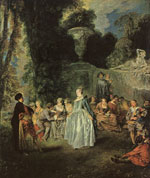
Les Fêtes d´Hébé , Time Magazine
took note and asked, "But can such a gentle artifice still
speak to the brutal and cynical 20th century? A hardy band
of performers is answering yes," going on to praise the company's
"glowing" productions.
The company
began to forge relationships with some of early music's foremost
orchestras, and in addition to frequent collaborations with Concert
Royal, has worked often with Nicholas McGegan's Philharmonia Baroque
Orchestra, Christopher Hogwood's Academy of Ancient Music, John
Eliot Gardiner's English Baroque Soloists, Ryan Brown's Opera Lafayette,
Apollo's Fire of Cleveland, and with the National Symphony Orchestra,
the Dallas Bach Society, the New World Symphony, the Smithsonian
Chamber Players, and the Monteverdi Orchestra; the company has appeared
at the Spoleto Festival USA, The Kennedy Center, the Mostly Mozart
Festival at Lincoln Center, the Boston Early Music Festival, Germany's
Handel Festival, and in cities throughout Canada, England, France,
Germany, Japan, and Mexico. New York seasons have often been
sponsored by the Alliance Française.
The
NYBDC today |
Jacoby eventually decided to retire from the stage in pursuit of
research interests, publishing articles on baroque dance, and supplied
the English translation of Francine Lancelot's long-awaited La
Belle Dance . A number of dancers have come and gone
from the company in its 30-year history, and the current group is
notable for its connections to the world of contemporary dance as
well as for its immersion in Turocy and Jacoby's model of the "scholar-performer."
Many of the dancers are fluent in Feuillet notation and have
become influential presences in the early dance scene, teaching
and guesting at universities across the country. The company's
presence has been of wide-reaching consequence: there are few people
working in the field, especially in the United States, who cannot
trace their lineage to the NYBDC.
Esteem for the company's achievements continues to grow.
In 1995, Turocy and Richman were decorated by the French Ministry
of Culture in the Order of Arts and Letters as Chevaliers (knights),
in recognition of their outstanding work. And in 2000, Turocy
was awarded New York's BESSIE for Sustained Choreographic Achievement,
for "a truly experimental reanimation of Baroque dance and
the world out of which it emerged."
The NYBDC is honored to be among a select group of dance companies
designated for archiving by the Dance
Division of the New York Public Library for the Performing Arts.
Videotapes of the company's productions since 1976 are on view at
the Jerome Robbins Archive of the Recorded Moving Image.