|
|
How We
Revive Baroque Ballets

click to see a larger image

"Jean-Antoine Watteau´s 'Fetes Vénitiennes'
(1718-19) -- a masterpiece of the fetes galantes style -- offers
a fanciful rendering of Venitian carnival dancing, perhaps in
reference to Campra´s popular opera-ballet, Les Fetes
Vénitiennes"
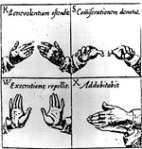
"A plate from John Bulwer´s 'Chirologia' (1644),
which gives a glimpse into both early forms of sign language
as well as 17th century gestural conventions"
|
The
NYBDC revives the operas, salon performances, court balls and street
shows of the 17th and 18th century. We hold steadfast to the
notion of the dancer-scholar, valuing both extensive research and
rigorous performance training, to ensure that our productions are
both historically accurate and living, engaging works of theater.
The process
starts with a consultation of original sources, and chief among
these are the more than 300 ballets from the 18th century preserved
in Feuillet notation. This system was devised at the behest of King
Louis XIV of France by the dancing master Pierre Beauchamp and refined
by the dancing master Raoul Auger Feuillet. Feuillet notation
illustrates the floor-pattern traveled by the dancers, and a series
of ticks and curves delineates the steps and their rhythm.
The corresponding bars of music run across the top of the page.
Knowledge of
how to read these complex notations goes hand-in-hand with an understanding
of the unique vocabulary of steps from the 18th century, and our
dancers have been trained - by Catherine Turocy, by other teachers,
and through their own research - to understand the subtleties of
the period style as well as the nuances of the notation system.
We acquire copies of these rare notations from online collections,
and from libraries and special collections from around the world.
But
while the Feuillet notation gives a thorough sense of the dances,
we believe strongly in consulting other primary sources to gain a
more complete picture. We examine relevant engravings and paintings,
read correspondences and publications describing original productions,
read acting manuals, dance manuals, treatises on etiquette, and when
possible, visit theaters, ballrooms and gardens to gain a sense of
the space in which these dances took place. In addition to
training in the baroque dance technique, our dancers study commedia
dell'arte - the dominant comedic form from the period - as well as
the gestural systems of various 18 th century movement theorists.
Our
work thus starts in the library, but moves soon to the rehearsal studio,
where we weave together the information from our primary sources and
labor to reconstruct dances that don't feel dry and academic, but
are dramatically compelling and offer an engaging glimpse into the
past. Sometimes, of course, there is a paucity of primary sources
- no surviving Feuilllet notation, for example - and this is where
what we do is more properly called a recreation: we search
out as many primary sources as possible, and then create new choreography
that draws on the fragments of information available, and fleshes
out the rest in a manner that adheres to the conventions of the period.
We then join with musicians - and we are fortunate to work with a
variety of baroque specialists who also value both scholarship and
vitality - and seek to harmonize our half of the equation with theirs.
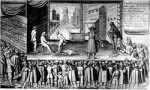
"A
French print (ca.1640) depicting a commedia dell´arte
street show"
|
|